Wouter & Ymke
Keeping the gods happy was rather important in ancient Rome. In Loyalty: Rome, you’re one of several senators trying to maintain the Pax Deorum, the peace between Rome and its gods. Of course, you’re also trying to become more prestigious than everyone else at the table. Apparently devotion and political ambition can go together quite nicely.
You’ll send messengers to different gods, compete for their favour and use their abilities to gather resources or interfere with other senators. You’re rarely doing any of this on your own. Other players can follow your actions, messengers keep changing position and the gods themselves come and go. Loyalty: Rome is one of dlp games’ new releases for Spiel ’26 in Essen, where it will be available in a German/English edition. We went into our first game expecting a fairly straightforward majority game. Getting two messengers onto a god often turned out to be the easy part. Keeping them there until our next turn was another matter entirely.
👥 2-4 players, ages 14+
⌛ Playing time: 50-70 minutes
📝 Designer: Nicholas Paschalis
🎨 Artwork: Klemens Franz & Maxx Kattnig
🏢 Publisher: dlp games (review copy provided)


Gameplay Overview
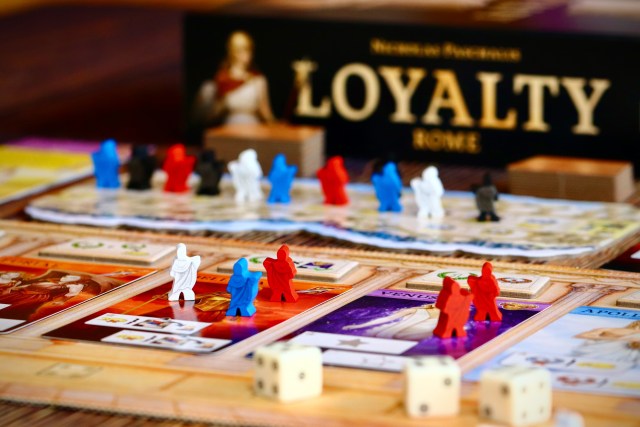
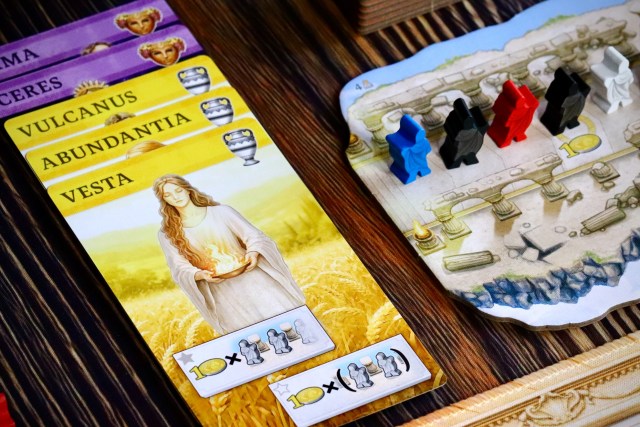
At the centre of Loyalty: Rome is the Pantheon, a row of six god cards. Each god has a favour token above it, while a changing number of influence dice can sit below it. Those dice determine which gods can normally be activated, while the favour tokens give everyone a reason to send their messengers to particular cards.
At the beginning of your turn, you check whether you control any gods. To claim a favour, you need at least two messengers on that god and more messengers there than any other senator. If you meet those conditions, scoring is mandatory. You take the favour, all messengers on that card return to their owners and the god is discarded. You also take the influence dice beneath it before a new god and favour enter the Pantheon.
Next, you check the influence dice you’ve collected. If you have three or more, you roll all of them and return them to the Pantheon according to their results. With one or two dice, you can choose whether to roll them. The number of dice available below each god therefore keeps changing, and sometimes a god you wanted to visit simply isn’t available through the normal action.
You then choose one action. Most of the time, this means selecting a god with an influence die, placing one of your messengers there, taking a die and using that god’s main or general action. Gods can give you coins or laurel wreaths, move messengers, change favour tokens, manipulate dice or interfere with other parts of the Pantheon.
When you use a god, the other senators get a chance to follow. To do that, they place one of their messengers on the first available space of the temple track and then use an action from the same god. The general action is always available. To use the main action, they must already have one of their messengers on that god. Every messenger you send to the temple is also one you don’t have available elsewhere.
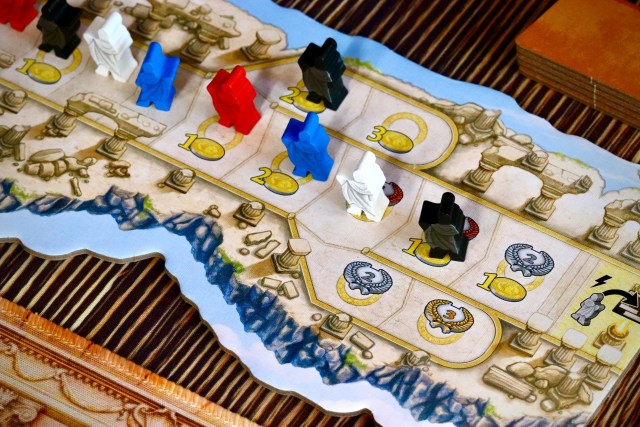
The temple track has spaces that provide coins and laurel wreaths, although you don’t collect them when placing your messengers. Instead, you can spend a later turn retrieving all your temple messengers and receiving the bonuses from their spaces. A messenger reaching the final space doesn’t stay there and instead moves directly onto another god. Your other action options allow you to take a coin and an influence die, or retrieve any number of your messengers from the Pantheon.
Most of your prestige comes through favour tokens. Some are simply worth a fixed number of points, while others score based on your coins, laurel wreaths, collected favours or the categories of gods you’ve scored. The game ends immediately when a god or favour can no longer be replaced, or when the final laurel wreath of one value is taken. After the final temple rewards, every messenger still on a god is worth one prestige as well. Whoever has the most prestige wins.

Artwork & Components
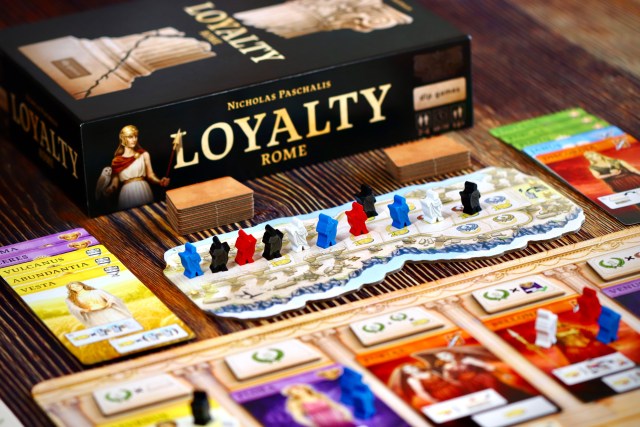
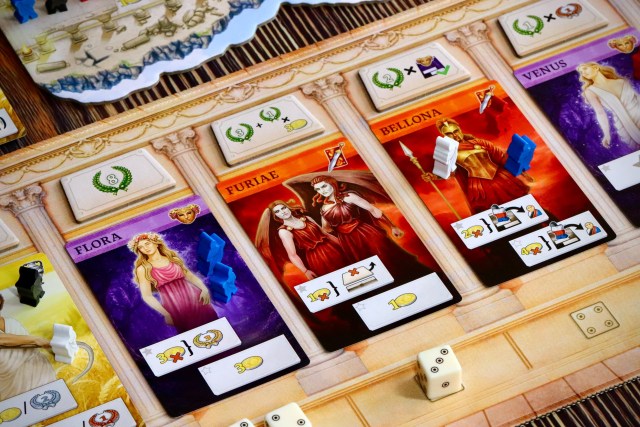
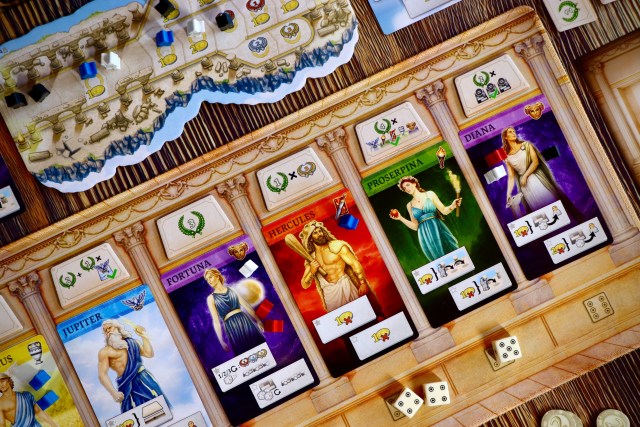
The first thing you’ll probably notice is the row of gods. Maxx Kattnig’s illustrations give each of them a very different appearance, and I like how colourful the Pantheon becomes once six gods are laid out together. The different card colours also make the categories easy to recognise. Add messengers, dice and favour tokens and there’s soon quite a bit happening in a relatively small area, although we rarely had trouble seeing who was competing where.
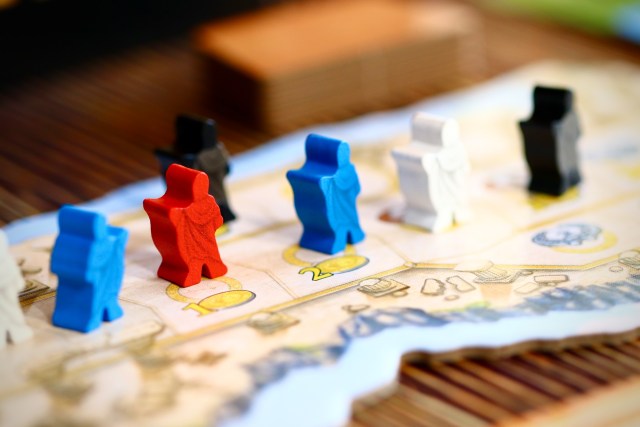
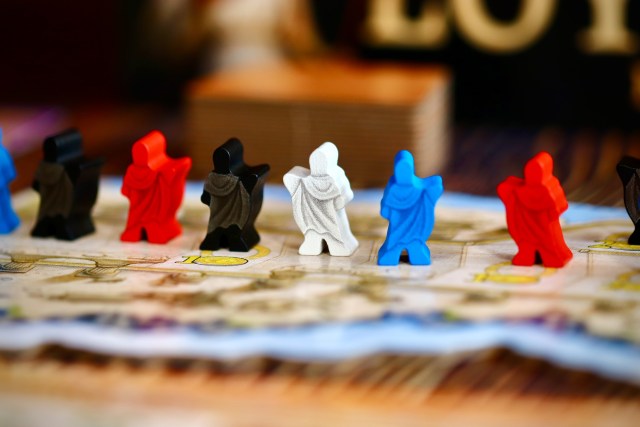
Then there’s the temple track, which has an irregular shape with ruins and stonework running along it. The colourful messengers gradually fill its spaces during the game, and the messengers themselves are chunky wooden figures shaped like little robed Romans. They’re simple, but I like them. Generic pawns would have done the job too, although these have a bit more character.
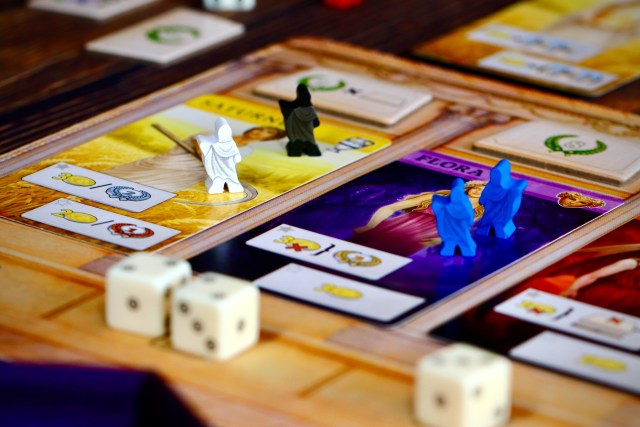
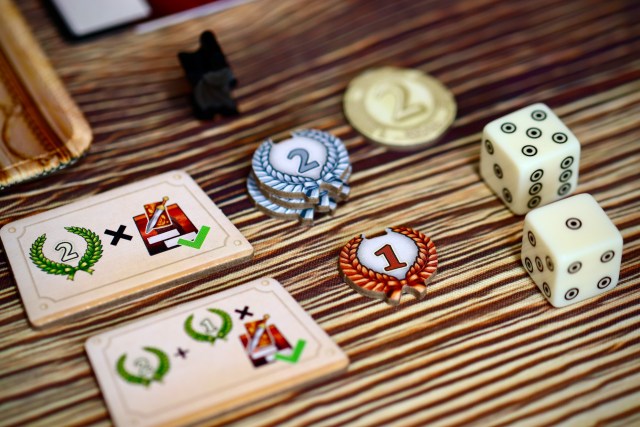
The influence dice are cream coloured with ringed pips, while coins, favour tokens and laurel wreaths make up most of the remaining cardboard. Everything follows the same Roman look without becoming too ornate. There’s quite a bit of iconography on both the god cards and favour tokens, and we had to check some of it during our first plays. Once we’d seen the same symbols a few times, we weren’t reaching for the rulebook as often.
Overall, the production gives the table enough Roman character without going overboard. Nothing made us stop the game just to admire a component, and nothing really got in our way either. Considering how many senators, gods and messengers are competing for attention, that’s probably more useful than giving us a miniature Colosseum to assemble before every game.

Our Experience
Our first game was mostly spent figuring out how much we should commit to each god. Two messengers seemed like the obvious target because that’s the minimum needed to score, so naturally we started putting pairs wherever we saw a favour we wanted. That worked until somebody moved one of those messengers, another player joined the contest and suddenly we’d used a third of our available pieces on something we weren’t even going to get. The rules themselves weren’t difficult and we had the basic structure down quickly. Reading what everyone else was preparing took us longer. By the end of that first game, those six messengers already felt rather fewer than six.
Following was probably the part we misjudged most. If somebody chose a useful god, our reaction was often basically, “Sure, I’ll have some of that too.” Then we looked down and realised several of our messengers were sitting on the temple track. At one point I had plenty I wanted to do and hardly anyone left to actually send anywhere. Very successful senator. Terrible staff management.
The temple itself gave us another reason to hesitate. Following could put us on a useful reward space, or leave the next available position for somebody else. The rewards only arrive when you eventually retrieve your messengers as well. There were plenty of moments where one of us wanted to bring everyone home while somebody else insisted there was surely room for one more follow.
Two messengers against somebody else’s one looked reasonably safe during our first game. It isn’t. Put that second messenger down when several other players still have a turn before you, and there’s plenty of time for them to interfere. Do it shortly before your next turn and suddenly there may not be much anyone can do about it. We had several majorities that looked almost identical on the table and played out completely differently because of where we were in turn order.
Influence dice gradually received more attention around the table too. Someone taking the last die from a god could make that card much less convenient to reach, while a player sitting on several dice was eventually going to throw them back into the Pantheon. The gather action isn’t exactly the most exciting-looking option in the game, yet we used it more often than I expected. Sometimes we wanted the coin and die. There were also turns where we mostly wanted that die gone from that god. Once everyone noticed this, even a fairly uneventful-looking action could result in someone across the table asking why, exactly, you’d chosen that particular die.
We noticed all of this more with three and four players. There were more opportunities to follow, more people competing over the same favours and more changes to the Pantheon before our next turn. We preferred that slightly less predictable version of the game, although I wouldn’t read too much into that yet. It did mean we spent very little time ignoring what the other senators were doing.
Our Thoughts
A messenger in Loyalty: Rome ends up doing several different jobs. You need it to use a god, two or more can secure a favour, and sending one to the temple is the price of following somebody else. Influence dice have a similar double use. They decide which gods can normally be reached, while taking one may also affect another player’s options. Then there are the favours. They provide most of your prestige, and their scoring conditions determine which gods and resources you care about. Even scoring one can remove an action you were hoping to use again.
This also means a favour worth very little to you can be exactly what the player opposite needs. You might put messengers onto a god without being particularly interested in scoring it yourself, simply because leaving it alone would make somebody else’s life far too easy. Spending two of your six messengers purely to be annoying has its own problems, of course. Rome apparently had inefficient politicians too. Whether that interference is worth it depends very much on what else those messengers could be doing.
You don’t control where influence dice return, and a newly revealed god can change what you were hoping to do next. Planning around one specific god still being available two turns later is asking quite a lot. There’s still room to work towards particular favour conditions or build up the coins and laurel wreaths you need, just not always by the route you had in mind. Players who like deciding on a long-term strategy early and then executing it efficiently may find that frustrating.
I’m also a little cautious about what the changing setup means for replayability. The gods, favours and dice can produce different situations, while the questions underneath remain familiar: where do you commit your messengers, when is following worth one of them, and which majority deserves a fight? We haven’t played enough to know how that balance will feel after twenty games. At this point, I’m happier leaving that as a question.
My main criticism is the amount of information you can end up checking before what looks like a simple turn. Once everyone knows what the gods and favours do, you actually start noticing more possibilities rather than fewer. Which players can follow this action? Can somebody move that messenger? How valuable is that favour to the player opposite you? What happens if you remove this die? With players who want to calculate every possible consequence, turns can take noticeably longer than the rules themselves suggest. There’s also an experience advantage because someone who already recognises the cards can spot opportunities that a first-time player simply won’t see.
After our first game, I mostly thought about the majority system. A few plays later, what stayed with me was how often the same messenger, die or favour mattered for several different reasons. I can see the amount of board reading putting some players off, and we still have questions about how it will hold up after many plays. We enjoyed our later games more than our first, though, and I’d happily return to the Pantheon to see whether that continues. Preferably with enough messengers left to actually do something this time.
📝 We received a copy of Loyalty: Rome from dlp games.
Going to Spiel Essen ’26? Loyalty: Rome will be available at dlp games’ stand in Hall 3, booth C115. You can also find our other Spiel ’26 reviews here.