Wouter & Ymke
Building a cathedral is complicated. You need marble, wood, metal, glass, skilled workers and, apparently, a very good supply chain. Opera Magna takes us to Renaissance Florence, where each player runs a workshop helping with the construction of the Cathedral of Santa Maria del Fiore. We’re not the architects deciding how the cathedral should look. We’re the people trying to make sure the materials actually get there.
That means travelling between Venice, Antwerp and Constantinople, buying raw materials, turning them into useful goods, improving our workshop and sending whatever we can to Florence. It’s an economic Euro at heart, with a shared trading system that keeps changing as everyone plays. There’s quite a bit going on when you first look at the table, although the basic process isn’t too difficult. The harder part is getting everything to connect without ending the turn with a perfectly good church bell and absolutely nowhere to put it.
👥 2-4 players, ages 14+
⌛ Playing time: 60 minutes
📝 Designers: Tommaso Battista & Stefano Castelli
🎨 Artwork: Lara Ongis
🏢 Publisher: Ludus Magnus Studio (review copy provided)
Opera Magna launches on Gamefound on 1 September. Pre-orders made during the campaign will include free shipping to all EU countries, as well as the UK and US.

Gameplay Overview
In Opera Magna, each player is a workshop master trying to score the most victory points over nine rounds. You have your own workshop board, three merchants and tracks for four raw materials: lead, wood, marble and sand. These materials can eventually produce four refined goods: bells, planks, columns and glass. Around your workshop, you’ll also construct buildings that improve what you can do during the game.
Most turns start in one of three cities: Venice, Antwerp or Constantinople. Each city has a cost area and a profit area, and your merchants move between these areas throughout the game. You must move one merchant on your turn, and you can’t move it to an area that already contains one of your other merchants. The trade cards in the area you enter then shift to the left, the oldest one is removed, and you add a new card from your hand on the right. After that, you activate the city. You pay everything shown on the cost side and receive everything on the profit side.
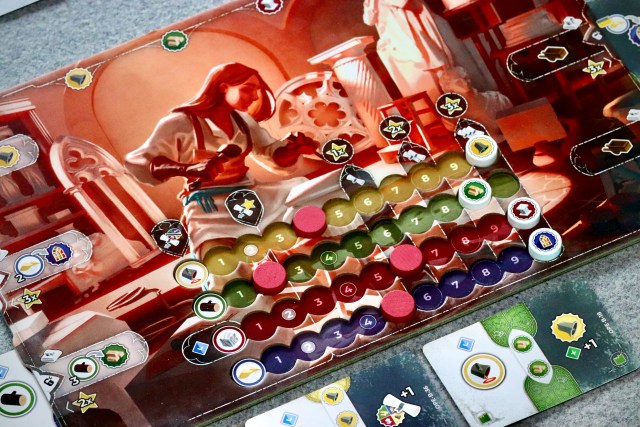
Raw materials stay on tracks on your workshop board. Gaining more of a material moves its marker to the right, where it can push the matching certificate along with it. Certificates have three levels and are important when you want to contribute to the cathedral. They can also cover a raw material you’re unable to pay by moving the corresponding certificate backwards. There are limits to how far you can do this, so eventually you’ll need the actual material.
Refined goods work differently because you normally can’t save them for a future turn. Once you’ve produced bells, planks, columns or glass, you need to use them. They can go towards constructing buildings or the Opera, or you can convert them back into their matching raw material. Buildings don’t need to be finished immediately, so goods can be added to them over several turns. Anything you still haven’t used at the end of the refined goods phase is discarded.
Completed buildings are added to either side of your workshop. Those on the left give discounts and unlock conversions, while the right side provides special effects and unlocks carts. You need those carts to send refined goods to the Opera, with each available cart allowing you to send one good per turn. The cathedral contains several worksites with different requirements. You need the correct refined good and certificate level, and you can only contribute once to each worksite. Higher worksites depend on progress below them, while the first player to reach a worksite resolves its special effect.
At the end of your turn, buildings are replenished when necessary and you take another trade card from the market. The leftmost card is free. The others cost raw materials, giving you more choice if you’re willing to pay for it. The trade card supply also works as the game clock. After nine rounds, points come from completed buildings, workshop development, certificates, contributions to the Opera and several other sources. Your presence at the cathedral compared with the other players matters too. Whoever ends with the most points wins.


Artwork & Components
There’s quite a bit on the table once Opera Magna is set up. Everyone gets a large workshop board, while the three city boards and the Opera board fill most of the shared space. Add the building cards, trade cards, market board and all the smaller pieces, and this isn’t exactly a game you’ll squeeze onto the corner of a coffee table.
The workshop boards were the first thing that caught my attention. Each character is different, and the illustrations give the boards much more personality than if they were simply filled with tracks and icons. The Opera board does the same for the centre of the table. You can see the cathedral under construction, gradually filling with everyone’s contributions as the game goes on. Warm colours, workshops, merchants and city illustrations make it very clear where and when the game is supposed to take place without getting in the way of the information you need.
I like the merchants too. They’re chunky wooden pieces with printed characters instead of basic coloured meeples, which is a small detail that works well here. The layered workshop boards are useful, especially with several resource markers moving around during the game. We needed some time with the symbols, but they became easy enough to read.
The component issue we kept noticing was the card handling. Trade cards are constantly sliding along the city boards and being replaced, while completed buildings get tucked around your workshop. It’s fiddly. Nothing serious, just a lot of little adjustments throughout the game. After nine rounds you’ve done quite a bit of Renaissance paperwork.


Our Experience
Opera Magna clicked with us quickly. Despite the amount of information spread across the table, we didn’t spend very long struggling with the basic structure. Our own workshops got most of our attention in the first game. Better conversions sounded useful. Discounts sounded useful. More carts certainly sounded useful.
So we built. And then we built some more.
Somewhere along the way, we remembered that Florence was actually waiting for us to contribute to its cathedral. We became less enthusiastic about adding yet another building after that. With only a few rounds left, a lovely new workshop improvement doesn’t have much time to earn its keep. Florence could survive without our latest renovation.
The cities took a little longer. We were mostly looking at what they could give us right now and not paying enough attention to where our merchants ended up. Then somebody would replace a trade card and a city we hadn’t cared about five minutes earlier suddenly became the place everyone was looking at. The stronger cards entering circulation made those changes more noticeable. We started following other players’ turns much more closely, hoping they’d leave something useful behind.
Merchant positioning caught us out several times. The trade you want can be sitting right there, ready to go, except your merchant is already in that area.
Too bad. Move somewhere else.
I found that annoying for a while. Eventually we were moving merchants away from useful areas specifically so we could come back. We even felt rather pleased with ourselves when we started doing this deliberately. Then, of course, there were the turns where we’d moved a merchant for some brilliant future reason and completely forgotten what that reason was by the time it mattered.
Refined goods produced quite a few “oh…” moments. You activate a city, collect a lovely pile of stuff and discover you can’t actually use half of it. We did this more than once. Suddenly everyone is checking the unfinished buildings. Can I put this there? Do I have a cart left? Can I send that one to the Opera? No? Fine, apparently this beautiful column is becoming marble again.
We were much more protective of certificates during our first games. Moving one backwards to cover missing raw materials felt like undoing something we’d worked for, especially when we wanted that certificate for a higher worksite. We’re less precious about them now. Giving up some progress can rescue a turn, and occasionally that’s exactly what we want to do. We’ve also sacrificed one and regretted it shortly afterwards.
The market went through its own little change in our heads. Why pay for a trade card when there’s a free one sitting right there? That seemed obvious enough. A few games in and we were happily spending materials because the right card could be far more useful than whatever happened to be free.


Our Thoughts
What I like most about Opera Magna is how often one thing in your workshop matters somewhere else. Collecting raw materials can push certificates forward. Those certificates get you into better worksites, or you can sacrifice some of their progress when you’re short on materials. Buildings score, while also giving you discounts, conversions, effects or carts. You end up looking around your workshop quite a lot before spending anything.
That works well for us. We don’t need another separate system added to make the game harder. The difficulty is already there in deciding where your resources are most useful. One material can solve the problem in front of you or help prepare something for later. A certificate you sacrifice now might be exactly the one you need soon afterwards. And every now and then you realise the trade you were so pleased with has produced one glass too many.
The economy grows noticeably across the nine rounds. Stronger trade cards appear, workshops can handle more and combinations that were impossible near the start become realistic. By then, there isn’t much time left. I like that progression. The final rounds feel busier simply because we’ve built the capacity to do more and now need to make use of it.
The interaction worked for us. It’s pretty polite. Nobody is constantly stealing your resources or blocking everything you want to do, although ignoring the other players is a bad idea. The cities keep changing and there’s competition around the Opera. Most interference comes from an opportunity looking different by the time your turn arrives rather than someone deliberately ruining your plans. If you want to actively get in each other’s way, Opera Magna probably won’t give you enough of that.
Replayability is the part I’m still unsure about. The buildings, city powers, worksite effects and trade cards change what’s available, while the general direction remains fairly consistent: improve the workshop, develop certificates and turn that work into points. I don’t know yet whether another ten or twenty games would give us genuinely different workshops or mostly different routes through the same plan. We haven’t played enough to answer that.
There’s randomness in which opportunities appear too. We’ve had the market produce exactly the card we wanted, and we’ve watched a city change just before we were planning to use it. Usually we found something else to do. Anyone who likes calculating several turns ahead with a reasonably predictable board may find those changes frustrating.
The repeated card sliding is a much simpler criticism. It’s fiddly. I don’t think there’s much more to say about that.
We’ve become more positive about Opera Magna the more we’ve played it. We regularly finish turns discussing where we wasted a resource, missed a better combination or prepared something one round too late. Quite often, we can see what we should have done almost immediately afterwards. That has made us want another go.
I’d happily bring it out with people who enjoy economic eurogames, resource management and developing their own board. It won’t be the right choice for someone looking for heavy economic planning or constant confrontation, and I’m still curious about how varied it will feel after many more games. Right now, though, we’re enjoying figuring it out. We started by wanting to build everything. Now we’re more interested in knowing what we can leave alone, what we actually need and when it’s finally time to stop improving the workshop and send something useful to Florence.
Going to Spiel ’26? Ludus Magnus Studio will also be bringing Opera Magna to Essen. You can find our other Spiel ’26 reviews here.
📝 We received a copy of Opera Magna from Ludus Magnus Studio.