Wouter & Ymke
Gulo Junior has got himself into trouble. He’s been caught by the swamp vultures, so the rest of the Gulo family sets off to find him. There is just one problem. Wolverines apparently have very little self-control when eggs are involved. Instead of focusing entirely on the rescue, they keep stopping at the vultures’ nest to steal some. The vultures, understandably, aren’t too pleased about this and have protected their eggs with an alarm.
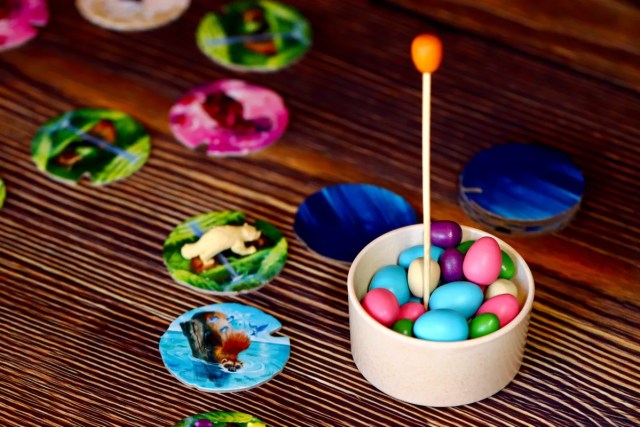
That gives Gulo Gulo a rather silly premise, but one that tells you almost everything you need to know about the game. We’re moving our wolverines towards Gulo Junior, but getting anywhere requires us to carefully remove colourful eggs from a crowded nest without setting off the alarm. It’s a children’s game with straightforward rules, but that nest gives everyone something very physical to deal with. And, as we found out, an egg that looks perfectly safe from your side of the table can become much less friendly once you actually touch it.
👥 2-6 players, ages 5+
⌛ Playing time: 20-30 minutes
📝 Designers: Wolfgang Kramer, Hans Raggan, Daryl Andrews & Jürgen P. Grunau
🎨 Artwork: Jennifer Meyer
🏢 Publisher: Pandasaurus Games (review copy provided)

Gameplay Overview
At the start of Gulo Gulo, a path of illustrated tiles leads from the players towards the nest. Each player chooses a coloured Gulo figure and starts beside the first tile. Your aim is to travel along this path, reach the nest, find Gulo Junior and successfully rescue him.
On your turn, you choose a tile ahead of your Gulo. You can choose any available tile up to and including the next face-down tile. If you pick that face-down tile, you reveal it. Each tile is linked to one of four egg colours, and whichever tile you choose determines which colour egg you need to steal from the nest.
You then choose an egg of that colour and try to remove it using one hand. You’re allowed to touch the other eggs while doing this, but you can’t deliberately move them out of the way. The alarm pole can move as well, but you don’t want it to touch the table. You also need to make sure no other egg falls out of the nest. Either of those things triggers the alarm and means your attempt has failed.
If you successfully remove your egg, it goes into the egg bag and your Gulo moves forwards to the next tile of that colour. This isn’t necessarily the tile you originally chose. If another tile of the same colour appears first, you have to stop there. If your attempt fails, you move backwards instead, stopping at the previous tile matching that colour. If there isn’t one behind you, you return to your starting position.
Whenever the alarm is triggered, all the eggs are collected, mixed in the bag and returned to the nest before the alarm pole is reset. There’s another way this reset can happen too. If you successfully remove the final egg of one colour, you reset the nest in the same way and then take another turn.
Once your Gulo is at the end of the path at the start of your turn, you begin circling the nest. Instead of choosing a tile from the path, you reveal the top tile from the nest deck and try to steal an egg of its colour. Succeed and the tile is added to the path, you move onto it and immediately take another turn. Somewhere in this small deck is Gulo Junior. When you reveal his tile, you need to successfully steal a purple egg to win. If you fail, Junior goes back to the bottom of the deck and your Gulo moves backwards one space. So yes, you can finally find the missing child and still decide that stealing one more egg is apparently essential.

Artwork & Components
The first thing that caught our attention when opening Gulo Gulo was obviously the nest. It’s a round container filled with 22 colourful eggs, with the alarm pole standing between them. There’s nothing particularly complicated about it, but once everything is assembled you immediately want to put your fingers in there and see what happens. That’s probably not great behaviour around a real bird’s nest, but here it’s rather useful.
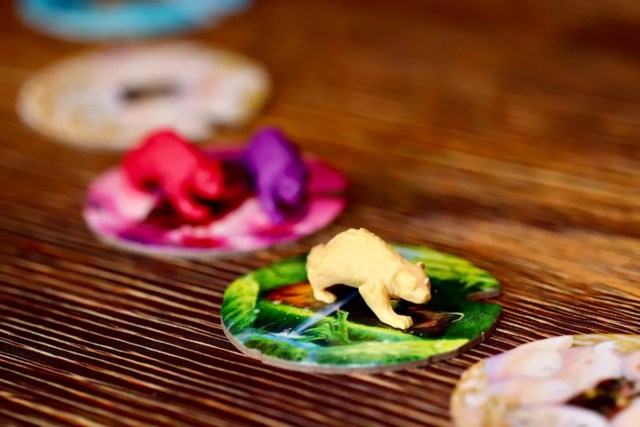
The Gulo figures are plastic wolverines in six different colours. They have enough detail to look like actual little animals rather than generic pawns, and their bright colours make them easy to follow along the path. The path itself consists of illustrated cardboard tiles. They don’t form a fixed board, so you can arrange the trail in different shapes as long as it remains one continuous path towards the nest.
I also like the illustrations. There’s a slightly unusual storybook quality to them, particularly on the box, where the dark blue forest and enormous nest make the whole egg-stealing operation look far more serious than it really is. The tiles are brighter and more colourful, while the purple Gulo Junior tile stands apart from the rest. Still, the nest is what people tend to look at first. As eggs disappear into the bag, gaps appear and the remaining eggs settle into different positions. Then someone sets off the alarm, everything gets mixed again, and the nest looks slightly different for the next attempt. It’s a fairly simple collection of components, but they give the game plenty of character on the table.


Our Experience
Gulo Gulo quickly became one of those games where we watched everyone else’s turn almost as closely as our own. During our first game, we mostly approached the nest as if the obvious egg was probably the right egg. See the colour you need, find one near the top, pull it out. Easy. That worked until somebody touched what looked like a completely harmless egg and several others started shifting underneath it. Suddenly everyone was staring at the alarm pole instead of the egg itself. Because we were all watching the same nest and could see exactly when things started going wrong, waiting for our turn rarely felt like much of a problem.
After a few games, we stopped automatically choosing whichever egg was easiest to reach. We started looking at how the eggs were sitting against each other, which ones had some room around them and what might move when one disappeared. We weren’t always right. In fact, some eggs that looked completely buried came out without any trouble, while an innocent-looking one near the top somehow seemed responsible for holding half the nest together. I mean, at some point you just have to accept that the nest knows more than you do. Removing an egg also changed what everyone else had to work with. Sometimes someone took exactly the egg we’d been eyeing. At other times they left behind such an unpleasant arrangement that we found ourselves almost hoping they’d knock something out and reset the whole thing.
The path took us a little longer to pay attention to. In our first game, most of our attention went towards successfully getting an egg out. Later, we started noticing that the colour we chose could make quite a difference. An easy-looking egg wasn’t always worth attempting if the next matching tile barely moved us forwards. Another colour might take us considerably further, but could also hurt more if we failed. We had several turns where somebody chose an egg, checked the path again and realised just a little too late what going backwards would actually mean. It never became a particularly difficult calculation, but by then we were checking the path before deciding which egg looked worth the risk.
We didn’t suddenly discover some hidden strategy after several games. Even then, getting the egg out was still much more important than planning several turns ahead. What changed was that we understood the consequences better. We weren’t just thinking, “Can I take that egg?” anymore. We were also thinking about whether that colour was actually worth the attempt.
The biggest surprise for us was how naturally children and adults could compete. Adults may be better at reading the path or judging which egg looks safest, but having larger hands isn’t exactly an advantage when you’re trying to reach between a pile of small eggs. Children can genuinely be better at getting into awkward spaces. We didn’t have to invent a handicap or deliberately make worse choices to keep things close. Sometimes the smaller fingers simply did the job better, which is a much nicer solution than asking an adult to pretend they somehow didn’t notice the obvious move.


Our Thoughts
For me, the nest isn’t just something attractive sitting in the middle while the real game happens elsewhere. Removing eggs is what moves you along the path, and every successful attempt leaves a different arrangement for whoever comes next. The alarm pole also makes failure very easy to understand. Nobody needs to check a symbol or calculate anything when it reaches the table. Everyone has already spent the previous few seconds watching it lean further and further in the wrong direction.
Gulo Junior needs rescuing, but his family apparently can’t walk past a nest without helping themselves to an egg. That’s exactly what you end up doing throughout the game. You can’t simply rush towards Junior like a responsible wolverine. You stop for eggs, get caught stealing them and sometimes run several spaces backwards as a result. Even after finally finding Junior, the standard game asks you to steal one last purple egg before you can win. It’s ridiculous, but it makes the story easy to follow because what you’re doing with your hands matches what these badly behaved wolverines are supposed to be doing.
The backwards movement is probably the part we’d be most cautious about. It means someone in front is never completely safe, because one failed attempt can remove a decent lead. You can successfully work your way towards the nest and then lose several spaces because one egg didn’t cooperate. We laughed at that more often than we were annoyed by it, but not everyone will. If losing progress regularly bothers you or your children, Gulo Gulo has plenty of opportunities to test that patience.
We’re slightly divided on the endgame, mainly because it can keep going after we already feel ready for someone to win. I like that reaching the nest doesn’t automatically end things and that you still have to find Gulo Junior. A few failures, however, can stretch out that final part, particularly when someone finally finds Junior and then fails to take the purple egg. His tile goes back into the deck and the search continues. The included Kid Gulo rules are useful for younger children because they remove that final purple egg requirement and make this part shorter. After a few games, though, you’ve probably seen most of what the path itself has to offer. What keeps changing is the nest and, perhaps more importantly, the people sitting around it.
Gulo Gulo is a children’s dexterity game, not a family strategy game hiding underneath one, and I think it’s better judged on those terms. We’re not going to bring it out when we want something more involved, and I can certainly imagine children eventually growing past it. What matters more to us is that when it is on the table, adults don’t have to sit there simply helping the children play. We can make our own choices, mess up our own egg attempts and genuinely lose because someone with much smaller fingers did a better job than we did. That makes it one of those children’s games we can actually enjoy playing together.
And honestly, watching someone spend half a minute carefully extracting the perfect egg only to knock another one out with their finger on the way back hasn’t stopped being funny.
📝 We received a copy of Gulo Gulo from Pandasaurus Games.