Wouter & Ymke
Across the land run the Lung Mei, invisible dragon paths connected to the Four Auspicious Beasts: the Azure Dragon, Vermilion Bird, White Tiger and Black Tortoise. Energy builds when these paths continue in straight lines, while mountains interrupt and diffuse it. It’s a rather grand explanation for what soon becomes two people placing stones and trying not to leave anything useful for the other player.
In Azure, those stones form connections across a shared realm. They help you gather qi, gain wisdom and attract the favour of the four beasts. The mythology gives the board a bit more personality than a plain collection of coloured spaces, although, let’s be honest, you’ll spend most of the game staring at rows, columns and mountains. The question is whether all of that comes together to create an interesting two-player puzzle.
👥 2 players, ages 8+
⌛ Playing time: 20 minutes
📝 Designers: Trevor Benjamin & Brett J. Gilbert
🎨 Artwork: Kwanchai Moriya
🏢 Publisher: Bitewing Games (review copy provided)
Gameplay Overview
Azure is a two-player game in which both players place stones into a shared realm made from four domains. These boards are shuffled, flipped and rotated during setup, so the positions of the spaces and mountains change from one game to another. According to the rulebook, this creates more than 10,000 possible layouts, although I’ll admit we didn’t sit down and count them.
On your turn, you place one of your stones on any empty space. Every space has a card cost. The colour of the domain tells you which colour of qi card you must pay, while the number of boon symbols tells you how many cards it costs. After paying, you place your stone and collect the boons shown there. These give you matching qi cards, wisdom points, or a mixture of both. There’s no hand limit, so cards can be saved for a later move instead of being spent immediately.
Your other stones can reduce those costs through bonds. Each of your stones in the same horizontal or vertical line as the chosen space provides one bond, which replaces one required card. Mountains block these lines, but player stones do not. With enough bonds, the cost of a space can even be reduced to zero. A stone several spaces away can therefore still help you, provided there isn’t a mountain sitting between the two and spoiling the view.
After collecting your boons, you check the Four Auspicious Beasts. Each beast is linked to one mountain, although the way stones guard that mountain differs between them. The first player to have two stones guarding a beast claims its favour. After that, it changes sides only when the other player has more guarding stones.
The Azure Dragon and White Tiger are guarded by stones in line with their mountains, unless another mountain blocks the route. Taking their favour gives you three and two wisdom respectively, but you lose those points if the beast later changes sides. The Vermilion Bird is guarded by stones anywhere in the vermilion domain. It gives you two cards from the hidden deck, although losing it means returning up to two cards from your hand.
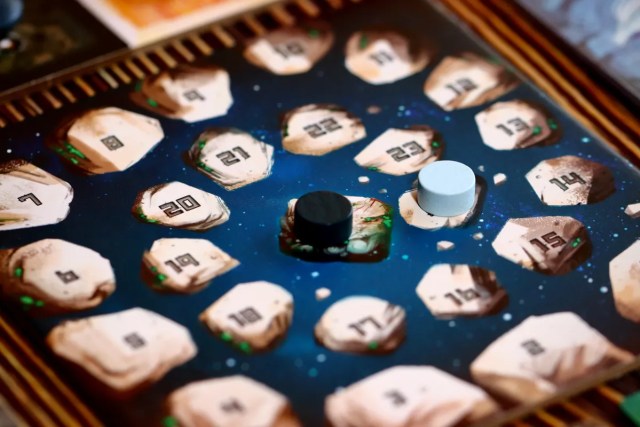
The Black Tortoise works differently. It counts your stones on serpent spaces across all four domains. When you gain its favour, you place one of your own stones onto the black mountain. That stone creates bonds along its row and column and may also help guard the Azure or White mountain. It remains there only while you control the Tortoise. The first player to reach space 25 on the wisdom track wins. You also win immediately if your opponent reaches a turn on which they cannot place a stone.


Artwork & Components
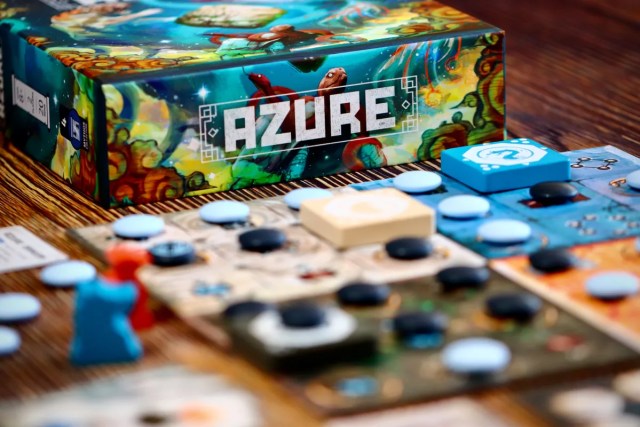
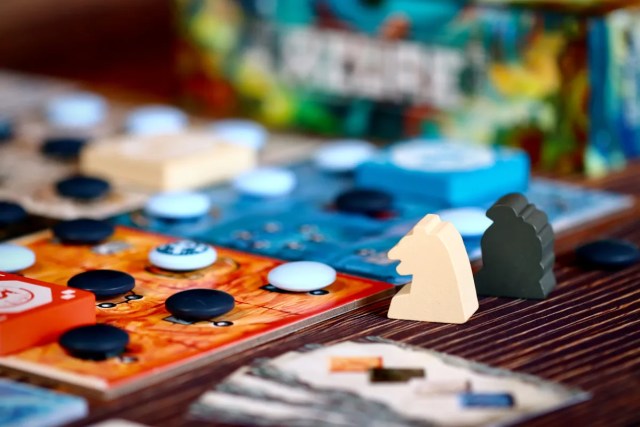
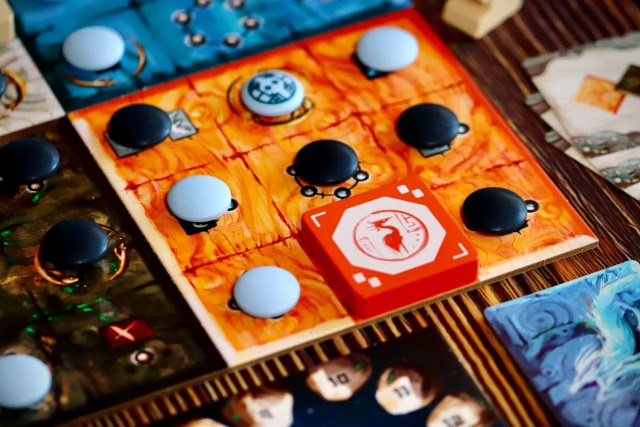
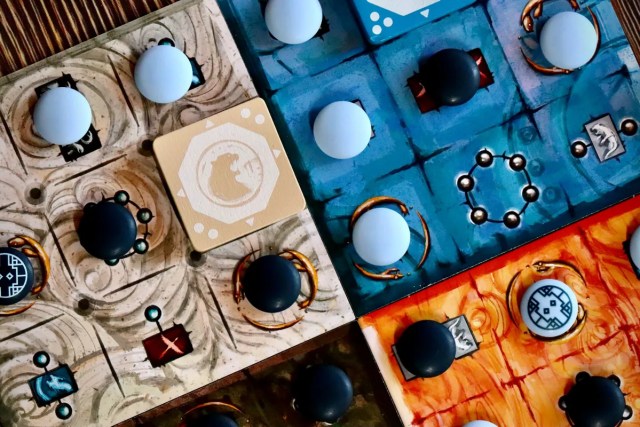
Azure is very colourful for a game built around such direct placement rules. The four domains each have their own palette, with blue, white, vermilion and black areas forming the realm. Brush-like lines and swirling details run across the boards, helping them feel like parts of one landscape even though they change position every game.
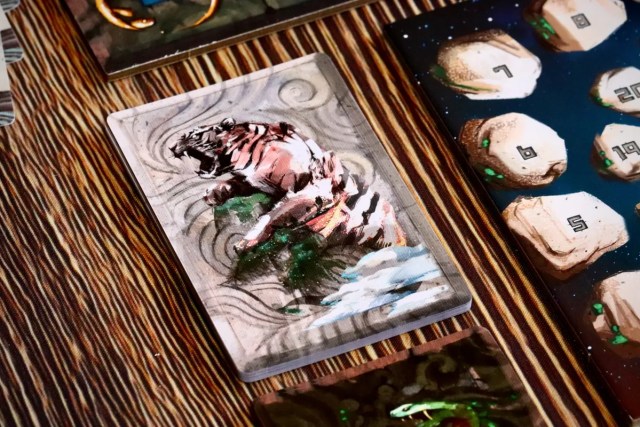
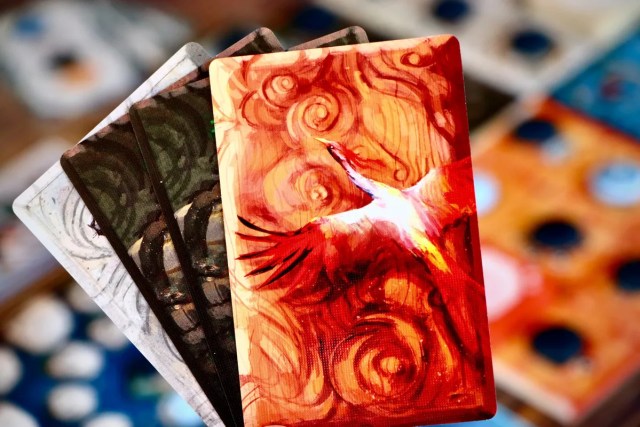
The artwork on the box and cards gives each beast its own personality. The Azure Dragon twists through a blue sky, the Vermilion Bird looks suitably fierce, and the White Tiger appears ready to object to wherever you place your next stone. The darker colours around the Black Tortoise make that part of the board feel heavier than the others. I liked that the four areas are easy to tell apart without looking as though they belong to completely different games.
Inside the box are 28 player stones, four mountains, four beast pieces, qi cards, score markers, player aids and a separate wisdom track. The wooden beasts are large enough that changing control is immediately obvious across the table, and physically taking one from your opponent feels more noticeable than simply moving a marker. Thankfully, nobody at our table made dragon noises.
There’s quite a lot going on visually, but the symbols remain readable. That matters because you’ll spend much of the game checking costs, rewards, serpent spaces and lines between stones. Once both colours have spread across the realm, the position itself can take some effort to read, but we never struggled because of the artwork. The optional gifted module also looks like a useful addition once you’ve learned the base game, though we’d leave it in the box for your first few plays.

Our Experience
Our first game involved quite a few placements that seemed sensible at the time and looked much less sensible one turn later. We understood that bonds reduced future costs, but we didn’t yet see how far a useful line could reach. Instead, we mostly chose spaces for what they gave us immediately, especially anything with wisdom on it. That worked for a while, until one of us had spent most of their cards and the other had created several lines that made later placements much cheaper.
By our second and third games, we were looking at the board differently. A space with several wisdom points wasn’t automatically the obvious choice anymore. We started asking what would happen afterwards. Would the stone create two useful bonds? Would it leave an important space available to the other player? Could we wait a turn, or would that give the other person exactly the opening they needed? We still made mistakes, but at least they became slightly more informed mistakes.
One thing we kept underestimating was how many jobs a single stone could perform. We’d place it to collect cards, then realise it also guarded a mountain and completed a useful line. At other times, we’d focus so much on improving our own position that we failed to notice what the placement did for the other player. There were several moments where one of us confidently finished a turn, followed by a pause, some recounting and a much less confident, “Oh.”
The beasts also changed how we approached particular spaces. During our first game, we treated them as bonuses that might be useful if they happened to come our way. That didn’t last long. The Azure Dragon moved between us several times, taking three wisdom with it on each change, and suddenly the lines around its mountain received much more attention. Sometimes we gave up a better immediate reward simply to stop a beast from changing sides. At other times, we ignored one because contesting it would cost too much elsewhere.
The Black Tortoise caused the most discussion. Whenever it changed hands, both of us had to stop and look at the realm again because its mountain stone altered several possible connections. This usually ended with both of us leaning across the table and tracing invisible paths with our fingers, which is probably exactly how ancient geomancers worked.
Our Thoughts
Most abstract games are mainly about where you place your pieces. Many euro games ask you to build an engine that makes future turns more efficient. Azure sort of mixes those ideas together. Your engine is your position on the board. Every stone you place makes certain future moves cheaper along its row and column. Instead of building an engine beside the board with cards or a personal tableau, you’re building it directly into the realm itself. For us, that’s the part that gives Azure its own character.
The interesting thing is that this engine is completely visible. Your opponent can usually see which lines you’re developing and which spaces you’re trying to make cheaper. More than once we spent a few turns setting something up, only to watch the other player take exactly the space we’d been working towards. That meant we were often weighing up whether to continue our own plan or get in the other person’s way first.
Randomness plays a fairly small role. The hidden deck affects your starting hand and the cards gained through the Vermilion Bird, but most qi comes from visible spaces and face-up decks. Honestly, most of the trouble we got ourselves into came from our own decisions rather than the cards. If we lost an important space, it was usually because we’d left the door open ourselves.
Once the realm starts filling up, the game asks quite a bit from both players. You’ll find yourself counting bonds, checking mountains and comparing beast control before committing to a move. The rules stay approachable, but reading the board becomes more demanding as the game goes on. Players who enjoy studying a shared position may enjoy that process. Those looking for something they can play while chatting about their week may find that Azure asks for a bit more attention.
Experience also matters. Someone who already understands how to build useful lines will usually have a noticeable advantage over someone learning the game, and there aren’t really any catch-up mechanisms if your position starts falling apart. Once a player has created several cheap routes across the realm, it can be difficult for the other person to match that efficiency. I wouldn’t call this unfair, but it does make Azure a better match when both players understand what the board is asking of them.
We also found the beasts a little uneven in how interesting they were to chase. The Azure Dragon, White Tiger and Vermilion Bird all have their uses, but the Black Tortoise kept pulling our attention back because it actually changes the board instead of simply giving points or cards. That doesn’t necessarily mean it’s stronger, but for us it was usually the beast that caused the most discussion.
Azure is still very much a game about cards, lines and position. The mythology gives those systems a nice setting, but it never gets in the way of the abstract puzzle underneath. Players who want a strong story during play may find it a little dry, and this probably isn’t the best choice for someone looking for a relaxed two-player game that only needs half their attention.
For us, though, the amount of concentration it asked for was generally worth it. We liked seeing plans develop on both sides of the table and deciding whether to keep building our own network or interfere with someone else’s. Not every beast felt equally interesting, and some turns definitely took longer than we’d have liked, but we finished every game talking about what we’d do differently next time. That’s usually a good sign.
📝 We received a copy of Azure from Bitewing Games.