
 Wouter & Ymke
In Crops, you have twelve turns to build a field of vegetables in a 3 by 4 grid. You place crop cards, connect matching family symbols, add goals to individual columns, and create moon phases between neighbouring cards. The problem is that a card rarely helps with everything at once. The carrot that completes one symbol may create the wrong moon beside it, while the pepper that fits your goal may leave you with a space you’ll regret later.
That’s basically where Crops gets its game from. The turn itself is simple, but the field becomes less forgiving as it fills up, and the cards in the market won’t always suit the plan you had in mind. So you adjust, place the vegetable that causes the fewest new problems, and hope the moon agrees with your farming decisions.
👥 2-4 players, ages 10+
⏳️ Playing time: 25 minutes
📝 Designer: Giampaolo Razzino
🎨 Artwork: Mirko Properzi
🏢 Publisher: Little Rocket Games (review copy provided)

Gameplay Overview
A game of Crops lasts twelve turns. By the end, every player will have placed twelve crop cards into a field of three columns and four rows. You can also place goal cards above and below those columns, with each goal checking only the four crop cards in the column where it sits. At the start, everyone receives three crop cards. You also get four goal cards, choose two to keep, and return the others to the deck.
Two shared markets are placed in the middle of the table. The crop market has two rows of face-up cards. In a two or three-player game, each row contains three cards, while four-player games use four cards in each row. The goal market contains three cards, or four with four players. If none of the visible cards suits what you’re doing, you can sometimes draw blindly from the corresponding deck instead. That can save a turn, or give you exactly the wrong onion. You know how card draws work.
Every turn begins with a mandatory swap. You exchange one crop card from your hand with one card from the top row of the crop market. After that, you take another crop card, either from the bottom row of the market or from the top of the deck. This means you’re not only choosing what you want, but also deciding what you’re putting back into circulation. Sometimes you’re happy to hand over a card you can’t use. Sometimes you notice that another player has been collecting root crops and realise you’ve just placed a perfect beetroot in front of them. Well done, farmer.
You then play one crop card into your field. Your first card can go anywhere, but every later card must be placed horizontally or vertically next to one already there. Diagonal placement doesn’t count. Your field also has to remain compatible with its final 3 by 4 shape at all times. You can’t build five cards across and promise yourself that you’ll somehow repair the farm later. In the early turns, that restriction doesn’t feel especially severe. Near the end, it becomes much easier to understand why it’s there.
The cards connect in two directions. Vertically, the top and bottom halves of neighbouring cards form crop family symbols. There are four families: fruit, root, seed, and bulb. A symbol counts only when the two halves match. Horizontally, neighbouring cards create moon phases: new moon, first quarter, full moon, or third quarter. A completed field always contains eight completed moon phases, and the phase that appears most often becomes dominant. Every crop card then scores according to the value printed for that phase. If two or more phases are tied, the game uses a fixed order: new moon comes first, followed by first quarter, full moon, and third quarter.
During your turn, you may also place one goal card above or below a column. Each goal card has an upper and lower condition. If you place it above a column, only the upper condition counts. If you place it below, only the lower one does. Once placed, it can’t be moved or removed. You’re allowed to place a goal before its column is complete, so the question is often when to commit. An early goal gives you time to build towards it, while a later one can be matched to the crops you already have. After placing a goal, you immediately take a replacement from the market or deck. At the end of the turn, both markets are refilled, and you should once again have three crop cards and two goal cards in hand.
After twelve turns, scoring begins. First, every crop scores according to your dominant moon phase. Then, for each crop family, you multiply the number of completed matching symbols by the total number of cards from that family in your field. Finally, you score the goals above and below your columns if their conditions have been met. The player with the highest total wins.


Artwork & components
Crops comes in a small box with seventy-two crop cards, thirty-two goal cards, and a scorepad. That’s basically it. There aren’t any wooden vegetables, tiny tractors, or unnecessary first-player markers shaped like a watering can. Honestly, I’m fine with that. Everything happens on the cards, so I never felt Crops needed extra tokens or pieces to explain what was already visible in the field.
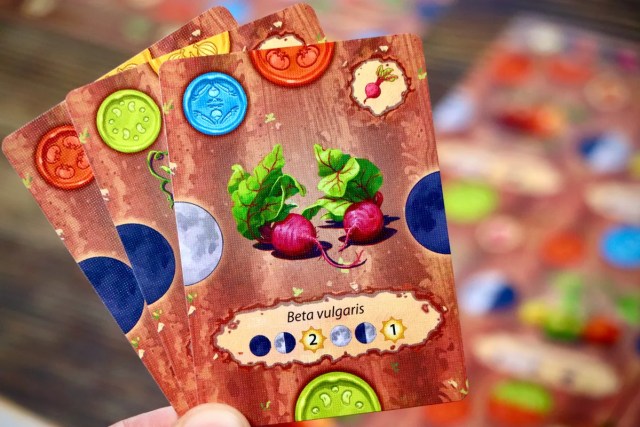
The illustrations have a painted, slightly rustic look, with warm browns, greens, reds, and yellows running through the game. Each crop is easy to recognise, and once several fields have been built, the table looks pleasantly full without becoming messy. Every card also includes the botanical name of its crop. I can’t say I finished a game with a new working knowledge of Latin, but it’s a nice detail. At least now I can look at an onion and pretend I know more than I do.
The main drawback is that the crop cards contain a lot of information. You’ve got the illustration, crop family, half-symbols at the top and bottom, moon halves on the sides, and four separate scoring values. None of this is badly arranged, but it takes a little time before your eyes know where to go. The goal cards are simpler. Some icons will still need a short explanation at the start, but they’re not difficult to remember.
By the end of the game, the three small fields look good beside one another, even if the individual crop cards take a little time to read. The painted vegetables and earthy backgrounds suit the subject without making the game feel aimed only at younger players. For us, the visual side worked well once everyone knew where to find the symbols.


Our experience
Our first game took longer than we expected, even though nobody had much trouble with the rules. The turn itself is simple, but we kept checking the same cards from several angles before placing anything. One person would compare two family symbols, someone else would remind them about the moon connection, and then we’d notice that the chosen column had a goal attached to it as well. By the second game, that process was already much faster. We knew where the information was printed, so we spent less time searching the cards and more time actually deciding what to do with them.
Our approach to goal cards changed quite a bit after that first play. Initially, we placed them early because it seemed useful to have a clear target. Sometimes that worked, but we also found ourselves trying to force a column towards a goal that no longer suited the cards appearing in the market. Later, we became more patient and waited to see which columns were developing well. That felt safer, although waiting too long has its own problem because you can play only one goal per turn. We didn’t find one method that always worked, and I liked that our timing changed from game to game.
The mandatory swap made us pay more attention to one another than we expected. Crops is still mainly about your own field, but the market means you can’t completely ignore what’s happening across the table. We regularly noticed which crop families somebody was collecting and hesitated before placing a useful card into the top row. Sometimes we kept it for another turn. Sometimes we had nothing better to give away and simply accepted that another player would probably take it. It never turned the game into a fight, but it gave us enough reason to look up from our own fields.
The final few turns were usually the slowest. By then, the remaining spaces were limited, and a card that fitted physically could still cause problems for a goal or a moon phase. We had several turns where somebody checked every card, looked at the market, reconsidered the first option, and then returned to it anyway. I know that will depend on the group, but players who like to calculate every possible point may add quite a bit of time near the end. Once we became more willing to accept that some parts of the field wouldn’t work perfectly, our games moved faster and felt better. Not every vegetable needs to fulfil its full potential.


Our thoughts
For me, the strongest part of Crops is that all of its scoring comes from the same small field. The crop families use vertical connections, the moon phases use horizontal ones, and the goals look at individual columns. You’re not pausing the game to resolve separate systems or reading long card effects. Everything depends on where those twelve cards end up. The rulebook doesn’t take long to explain, but the difficulty comes from deciding which connection around a card matters most on that turn.
Crops is largely about dealing with restrictions. The field has a fixed size, cards have to connect, goals belong to specific columns, and the market won’t always provide what you were hoping for. You may begin by collecting root crops or aiming for full moons, but the market can push one column in another direction before the field is complete. That means the game isn’t really about waiting for one ideal card. Most turns are about finding a placement that helps enough without making the next few turns worse.
The dominant moon phase will probably be the part people disagree about. It gives you something to follow across the whole game, but it also determines the value of all twelve crops. A couple of late connections can therefore change your score more than you expected. The fixed tie order matters too, especially because new moon wins every tied count. I enjoyed keeping track of it, but I can understand players who feel that the moon has a little too much control over the harvest. The final scoring also takes some work. None of the calculations is difficult, but the winner isn’t always obvious until every crop, multiplier, and goal has been counted.
Crops doesn’t introduce a completely new type of game. Grid building, shared card markets, matching symbols, and personal objectives will all be familiar to people who play a lot of board games. What helps Crops is that they all depend on the same twelve cards, so the different parts feel connected rather than separate. I’m still interested to see how it holds up over many more plays, especially whether players keep trying different crop families and moon phases or begin following the same preferred routes. We still haven’t settled on whether it’s better to commit strongly to one family or spread the field across several goals, so there are approaches we want to try.
Crops is easy enough to explain and looks good once the fields are complete, but it still asks you to stay involved until the final card. I’d recommend it mainly to people who enjoy personal card layouts and games where the position of a card matters more than a written ability. It needs more concentration than the small box may suggest, especially near the end, but for us that was also the reason the game stayed interesting. I can easily see us bringing it out again and trying a different mix of families, goals, and moon phases. I’d rather have vegetables demanding my attention than another deck full of tiny text and twenty different abilities.
Not a bad harvest, really.
📝 We received a review copy of Crops from Little Rocket Games.


